

Key Takeaways
- The data wall problem limits model performance when relying solely on empirical data collection.
- Procedural generation acts as a solution by engineering controlled scenarios instead of waiting for them to occur.
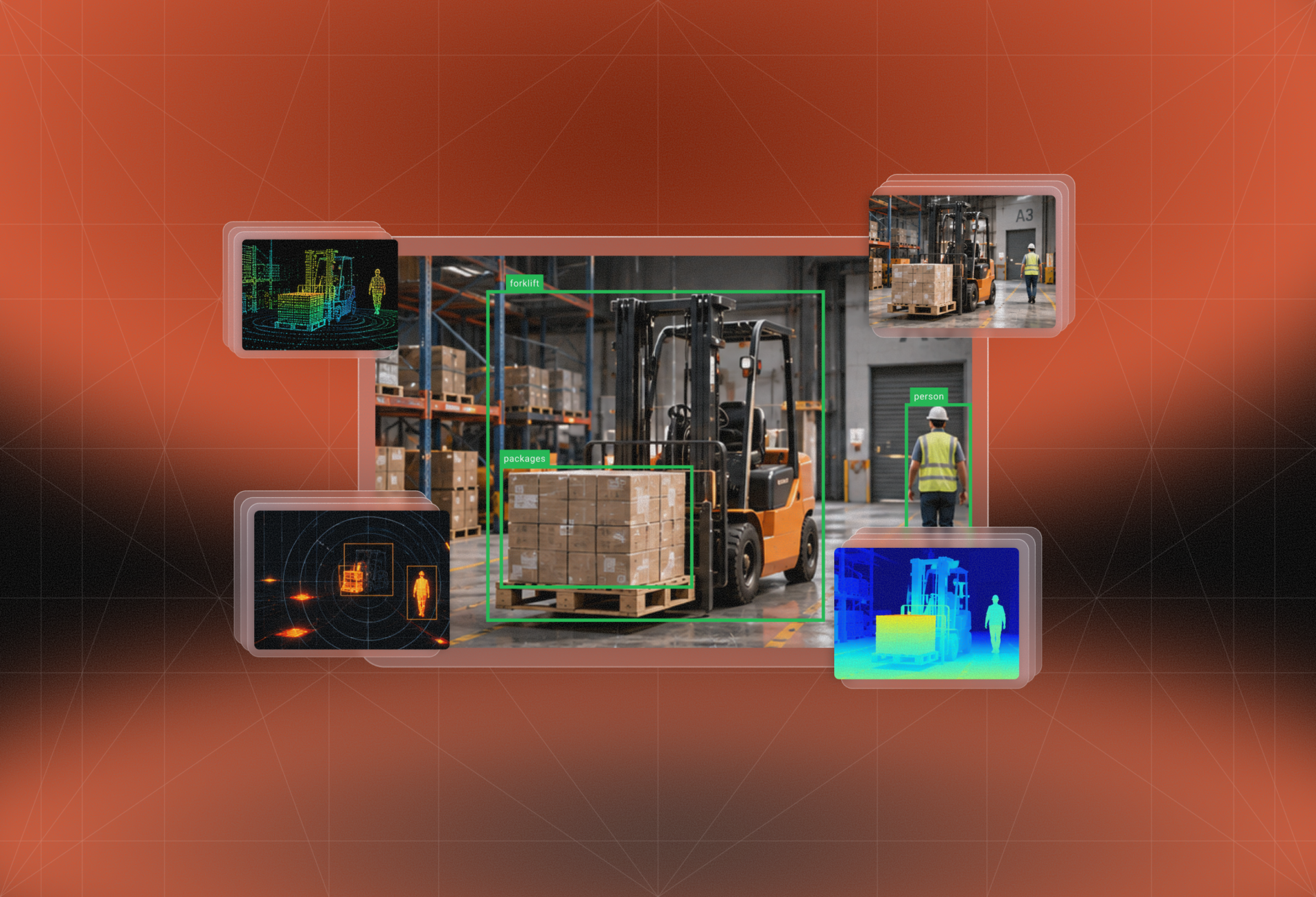
- Multimodal sensor simulation aligns camera, LiDAR, and depth data for complex enterprise applications.
- Deterministic ground truth provides simulation-consistent labels directly from scene geometry.
- Acknowledging and addressing the Sim2Real gap is a requirement for deploying simulation-trained models in physical environments.
- Secure enterprise deployment requires controlled infrastructure and on-premise processing for sensitive datasets.
Modern computer vision systems need training data that covers far more than common operating conditions. Models may need to recognize different environments, object configurations, sensor conditions, lighting conditions, and rare events.
The challenge is that the physical world does not produce these scenarios on demand. Capturing them can be expensive, logistically complex, or even unsafe.
Synthetic data generation changes this model. Instead of waiting for a specific scenario to occur naturally, engineering teams can deliberately construct it in a simulated environment and generate controlled variations at scale.
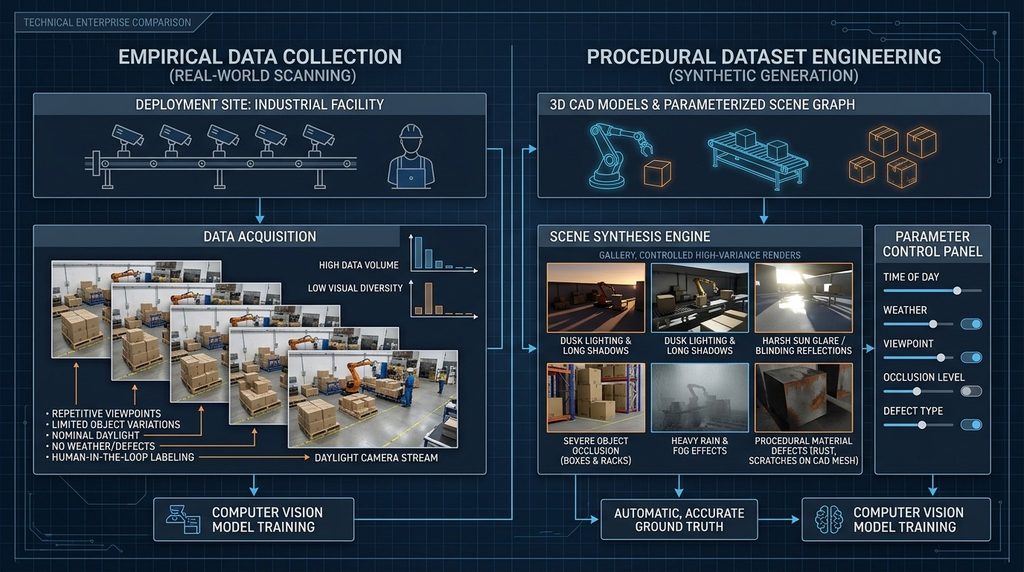
For sufficiently rare events, relying exclusively on empirical collection becomes statistically and operationally impractical. A manufacturing defect, for example, may occur only once every ten thousand production cycles, while an inspection model needs examples across multiple lighting conditions, orientations, and defect characteristics.
Procedural dataset engineering provides a way to construct these low-probability scenarios programmatically, filling specific gaps in the training distribution rather than simply adding more of the data that is already abundant.
Why Enterprise Computer Vision Needs More Than Real-World Data Collection
Real-world data remains essential for computer vision, but physical collection becomes increasingly inefficient when a model must learn rare events, controlled variations, or difficult-to-reproduce operating conditions.
The problem is therefore not simply how much data exists. It is whether the dataset contains enough of the right variation.
In practice, enterprise teams face three recurring constraints:
- Rare events: Safety-critical or unusual scenarios may occur too infrequently to capture at useful scale.
- Redundant volume: Large deployments can generate enormous amounts of footage without substantially increasing scenario diversity.
- Physical constraints: Some conditions are expensive, dangerous, or impractical to reproduce repeatedly.
This is where procedural generation becomes useful. Instead of scaling collection indiscriminately, engineering teams can target the specific portions of the distribution where data is missing or model performance is weak.
Model complexity consistently outpaces data availability in modern computer vision development. As architectures grow to process higher resolutions, multiple sensor inputs, and complex temporal sequences, they require correspondingly larger and more varied datasets. When physical data collection yields diminishing returns in variance, simulation allows engineering teams to target the specific distributions where the model underperforms.
From Data Collection to Procedural Dataset Engineering
What is procedural dataset engineering?
Procedural dataset engineering is a software-driven approach to creating synthetic training data by parameterizing environments, objects, sensors, and scenarios rather than relying entirely on physical data collection.
The fundamental shift is simple: instead of waiting for the required scenario to occur, engineers define the scenario and generate it.
If a model fails to detect an object under harsh backlighting, for example, the team can modify the relevant simulation parameters and generate thousands of controlled variations of that failure mode without recreating the physical environment.
The dataset therefore becomes an iterative engineering artifact. Engineers can adjust parameters, regenerate data, evaluate the resulting model behavior, and refine the generation pipeline based on observed gaps.
Procedural engineering provides parameterized control over nearly every aspect of the simulated scene. Engineers can define the geometry of the environment, the placement and orientation of objects, and the precise configuration of camera parameters such as focal length, sensor size, and distortion coefficients. Beyond structural elements, the methodology allows for granular control over transient conditions such as lighting across color temperatures, weather effects, material defects, object occlusions, and complex human poses.
How Synthetic Data Generation Creates Controlled Training Environments
Synthetic environments become useful when engineers can control the variables that influence what a model sees. Geometry, materials, lighting, atmospheric conditions, object behavior, and sensor parameters can be varied independently or in combination.
Several simulation techniques provide this control.
Physically Based Rendering and Ray Tracing
Constructing realistic synthetic environments relies heavily on physically based rendering (PBR) and ray tracing. PBR utilizes material models that react to light in a manner consistent with physical laws, defining properties like surface roughness, metallicity, and index of refraction. Ray tracing computationally models the propagation of light rays through a scene, allowing the renderer to account for effects such as reflections, refractions, shadows, and global illumination.
Modern synthetic-data pipelines combine physically based rendering and sensor simulation with neural scene-reconstruction techniques such as NeRFs and 3D Gaussian Splatting where appropriate. While PBR provides deterministic control over lighting and geometry, neural rendering techniques excel at synthesizing novel views from existing physical captures. Integrating these approaches allows pipelines to leverage the strengths of both procedural generation and empirical reconstruction.
Photometric Manipulation
Synthetic environments allow engineers to deliberately vary the conditions under which an object is observed.
For example, a pipeline can parameterize:
- Solar azimuth and elevation
- Light intensity and color temperature
- Specular reflections and glare
- Industrial lighting configurations
- Material-specific light response
These controls allow teams to construct difficult lighting scenarios rather than waiting for them to occur during physical data collection.
These effects are computed using the Bidirectional Scattering Distribution Function (BSDF). In practical terms, BSDF is a mathematical function that describes how light scatters when it interacts with a surface. By defining BSDF characteristics for different materials, the simulation can represent how a concrete wall responds differently to light than a polished steel pipe.
Morphological Variance
For automated optical inspection (AOI) models in manufacturing, training data must include diverse examples of product defects. Procedural generation synthesizes these defects directly onto CAD mesh surfaces. Engineers can programmatically introduce micro-cracks, material fatigue, and corrosion patterns that follow the physical geometry of the component.
This approach provides large-scale geometric and morphological variation without requiring thousands of physically defective parts. By varying the depth, scale, and distribution of simulated defects, the dataset covers a wide spectrum of potential failure modes, ensuring the AOI model can detect anomalies it has never encountered in a physical production run.
Kinematic Simulation
Capturing complex dynamic behaviors requires kinematic simulation. This involves modeling multi-body biomechanical dynamics to generate realistic skeletal poses, especially in heavily occluded scenarios. Simulating human movement around heavy machinery or multiple vehicles interacting at a complex intersection provides crucial training data for tracking and prediction models.
These kinematic simulations allow teams to stage scenarios that would be unsafe, restricted, or logistically impractical to stage physically. By constraining the procedural generation within realistic physical limits, the resulting animations provide accurate temporal data for video-based models.
Synthetic Data for Multimodal Computer Vision Systems
Modern perception systems increasingly combine multiple sensor modalities rather than relying on a single camera. Synthetic environments allow these modalities to be generated from the same underlying scene, with controlled spatial relationships and simulation-time synchronization.
| Sensor Modality | Key Simulation Considerations | Typical Synthetic Output |
| RGB Camera | Intrinsics, distortion, exposure, motion | Photorealistic 2D images |
| Depth Sensor | Scene geometry and sensor characteristics | Dense per-pixel depth maps |
| 3D LiDAR | Raycasting, beam divergence, attenuation, returns | Metric 3D point clouds |
| Radar | Radar cross-section, Doppler and micro-Doppler effects | Aligned radar observations |
The advantage is not simply generating more sensor data. It is generating aligned multimodal observations from a known scene state.
High-Fidelity 3D LiDAR Simulation
As autonomous systems increasingly rely on multiple sensor modalities, simulating non-optical sensors becomes critical. High-fidelity 3D LiDAR simulation uses raycasting pipelines to replicate the behavior of physical LiDAR units. The simulation models specific hardware characteristics, including beam divergence, pulse repetition rates, and multi-echo returns from complex surfaces.
To ensure the synthetic data matches real-world conditions, the simulation models range-dependent attenuation and backscatter under atmospheric conditions such as fog, rain, and dust. The software calculates how these particulate suspensions scatter the laser pulses, reducing the effective range and introducing artifacts into the point cloud. Comprehensive sensor noise modeling is also applied to replicate the range, intensity, timing, and dropout characteristics observed in physical LiDAR sensors.
Synthetic Sensor Fusion
Combining data from multiple sensor types requires precise spatial and temporal alignment. Synthetic sensor fusion utilizes known sensor geometry to align virtual cameras and LiDAR units. Because the environment is entirely software-defined, simulation provides deterministic simulation-time synchronization between disparate sensor streams.
The core of this spatial alignment relies on the projection matrix K[R|t]. In plain English, this is the mathematical formula that converts a 3D point in the simulated world into a 2D pixel on a virtual camera image. By applying this transformation, engineers can project synthetic LiDAR point clouds precisely onto the corresponding synthetic RGB images.
In simulation, relative sensor poses, intrinsics, timestamps, and coordinate transforms can be specified exactly, providing a controlled reference for sensor-fusion development. Instead of initially coupling algorithm development to the calibration drift and timing jitter of physical hardware arrays, teams start with known sensor geometry and calibration parameters, isolating algorithm performance from hardware error during the initial training phases.
Radar and Emerging Sensor Modalities
As simulation platforms mature, radar and additional sensor modalities are becoming part of the synthetic data pipeline, enabling cross-modal training for autonomous systems. Radar simulation models effects such as micro-Doppler signatures and radar cross-sections for various materials. Integrating these modalities alongside camera and LiDAR data provides a comprehensive synthetic testing ground for advanced perception stacks.
![Multimodal synthetic sensor simulation diagram displaying synchronized RGB camera view, 3D LiDAR point cloud sweep, and dense per-pixel depth map with projection matrix K[R|t].](https://obraz.com/wp-content/uploads/2026/09/image-5-1024x572.jpeg "Multimodal Synthetic Sensor Simulation: RGB, 3D LiDAR, and Depth")
Deterministic Ground Truth: Why Simulation Generates Its Own Labels
What is deterministic ground truth in synthetic data?
Deterministic ground truth is label information generated directly from the known state of a simulated scene. Because the simulation engine controls the objects, geometry, and spatial relationships, it can generate labels alongside the rendered data instead of requiring manual annotation afterward.
Depending on the task, a synthetic pipeline can generate:
- Semantic and instance segmentation masks
- Dense per-pixel depth maps
- 2D and 3D bounding boxes
- Object IDs for temporal tracking
- Surface normals and geometric vectors
- Scene-level spatial and coordinate metadata
This makes synthetic datasets internally consistent by construction. Segmentation boundaries, depth values, object identities, and other labels are derived from the same simulated scene state that produced the sensor data.
This automated labeling contrasts sharply with manual annotation, which is prone to human error, interpretation differences, and fatigue. Simulation-consistent ground truth means that the labels are internally consistent with the scene, eliminating annotator variance for synthetic frames.
Bridging the Sim2Real Domain Gap
Synthetic data does not automatically behave like physical data. The Sim2Real gap arises when the simulated environment differs from the conditions encountered by the deployed system.
The goal is therefore not to make every synthetic frame visually identical to reality. It is to ensure that the generated variation is useful for the target task and representative enough of the operating conditions that matter.
Four complementary techniques are commonly used:
- Domain randomization: Vary scene and environmental parameters to reduce overfitting to simulation-specific characteristics.
- Sensor and camera modeling: Reproduce relevant optical, sensor, and image-processing noise profiles.
- Environmental variation: Expose models to different weather, lighting, seasons, and material aging conditions.
- Real-world benchmarking: Evaluate the resulting model against representative physical hold-out data.
Domain Randomization
Deploying models trained on synthetic data into the physical world requires addressing the Sim2Real domain gap. This gap exists because even highly advanced simulations exhibit rendering artifacts and lack the full complexity of reality. Domain randomization addresses this by heavily randomizing textures, lighting, backgrounds, and object placement within the simulation to prevent overfitting to simulator artifacts. By forcing the model to learn the core features of an object rather than its specific simulated context, domain randomization improves generalization to physical environments.
Sensor and Camera Noise Modeling
Simulated images are often too pristine, lacking the imperfections introduced by physical lenses and image signal processors. Adding realistic noise profiles to the synthetic output is necessary to prevent models from learning unrealistically clean signals. This includes simulating chromatic aberration, lens distortion, motion blur, ISO noise, and compression artifacts to match the characteristics of the target hardware.
Environmental Variation
Models must perform reliably across changing physical conditions. The synthetic pipeline addresses this by introducing environmental variation into the training set. Procedural parameters can be adjusted to simulate different weather patterns, times of day, seasonal changes, and material aging. This ensures the model does not become overly reliant on a single, static environmental configuration.
Real-World Benchmarking
While procedural generation provides vast quantities of varied data, synthetic datasets cannot entirely replace physical testing. Synthetic data must ultimately be validated against real-world conditions to ensure the model performs as expected in deployment. Synthetic data generation should be informed by real-world measurements and validated against the conditions in which the model will operate.
From Synthetic Dataset to Production Computer Vision Model
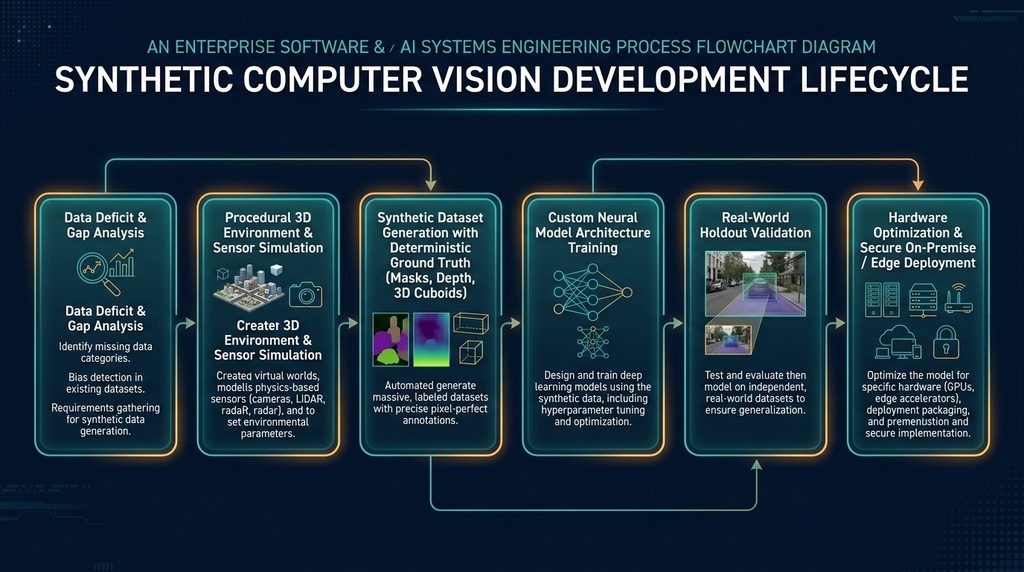
Synthetic data generation is one component of a broader computer vision engineering lifecycle. The process typically moves through six structured stages:
- Optimize for deployment: Optimize the validated model for its target hardware and operational environment.
- Identify the data gap: Analyze existing data and model performance to determine which scenarios, conditions, or edge cases are insufficiently represented.
- Engineer the synthetic dataset: Build procedural generation pipelines that parameterize the missing environments, objects, sensor conditions, and behaviors.
- Generate controlled variations: Produce synthetic examples across the defined parameter ranges, with simulation-consistent ground truth.
- Train and evaluate: Combine synthetic data with available real-world data where appropriate, using transfer learning or domain adaptation techniques when required.
- Validate against physical data: Evaluate the resulting model against representative real-world hold-out data to measure the Sim2Real gap and identify remaining failure modes.
This creates an iterative loop rather than a one-time dataset-generation process:
Data Gap Analysis → Synthetic Generation → Model Training → Real-World Validation → Failure Analysis → Dataset Refinement → Retraining
Throughout this process, procedural generation functions as an integral component of our broader computer vision development services.
Secure Deployment for Enterprise AI Systems
Synthetic data can also change how sensitive data is handled during model development.
Instead of requiring every development iteration to operate directly on protected operational datasets, teams can perform substantial portions of scenario generation and experimentation within controlled environments. This can reduce how frequently sensitive datasets need to be accessed, copied, or transmitted.
For regulated or security-sensitive applications, infrastructure requirements may also extend beyond public-cloud environments. Organizations with security, regulatory, contractual, or data-sovereignty constraints may require on-premises or otherwise controlled processing.
Common considerations include:
- Data residency and sovereignty
- Access control and identity management
- Protection of proprietary datasets and models
- Controlled synthetic-data generation environments
- Edge or localized model deployment
- Reduced transmission of sensitive operational data
Security therefore becomes part of the computer vision engineering architecture, rather than an afterthought added after model development. This secure approach to deployment is a critical aspect of our broader enterprise software development methodologies.
How Obraz Supports Enterprise Computer Vision Engineering
Obraz approaches synthetic data generation as part of a broader computer vision engineering workflow rather than as an isolated data-generation task.
Our work can span:
- Data-gap analysis: Identifying scenarios where physical datasets lack sufficient coverage.
- Procedural dataset engineering: Building parameterized environments and scenario-generation pipelines.
- Multimodal simulation: Generating aligned camera, LiDAR, depth, and other sensor data where required.
- Custom computer vision models: Developing architectures suited to the target perception task and sensor configuration.
- Edge optimization: Preparing models for resource-constrained deployment environments.
- Secure deployment: Supporting controlled infrastructure for applications with sensitive operational or proprietary data.
The objective is to connect synthetic data generation to the engineering problem it is intended to solve: improving the robustness of a production computer vision system. Learn more through our computer vision services, explore our data annotation services, or review our industry-specific solutions.
Exploring Synthetic Data for Computer Vision?
Procedural dataset engineering can help teams address data gaps that are difficult, expensive, or unsafe to reproduce through physical collection alone.
If your computer vision system has a specific scenario, sensor, or edge-case data gap, explore how Obraz approaches synthetic data generation and enterprise computer vision engineering.
Book a Technical Architecture Consultation
Frequently Asked Questions
What is synthetic data generation?
Synthetic data generation is the process of creating artificial training data using computer simulation and procedural algorithms rather than collecting data from the physical world. It allows engineers to parameterize and control elements like lighting, geometry, and sensor placement.
How is synthetic data used in computer vision?
Synthetic data is used to train, validate, and test computer vision systems by providing controlled examples of environments, objects, sensor conditions, and edge cases that may be difficult or expensive to capture physically.
What is procedural dataset engineering?
Procedural dataset engineering is the methodology of using software to systematically generate and control the parameters of a synthetic dataset. It shifts the focus from manually collecting and annotating data to writing code that defines the specific scenarios a model needs to learn.
How does synthetic LiDAR simulation work?
Synthetic LiDAR uses raycasting to simulate the emission and return of laser pulses within a 3D virtual environment. The simulation calculates the intersections of these rays with virtual objects, modeling material properties, beam divergence, and atmospheric attenuation to generate a realistic point cloud.
What is the Sim2Real domain gap?
The Sim2Real domain gap is the difference in performance when a model trained in a simulated environment is deployed in the physical world. It occurs because simulations cannot replicate all the noise, artifacts, and complex physics present in reality.
How does synthetic data support sensor fusion?
In a simulated environment, different virtual sensors (like cameras and LiDAR) can be placed with precise geometry and triggered simultaneously. This provides controlled, precisely aligned multimodal data that helps train models to fuse disparate sensor inputs without dealing with physical calibration errors.