
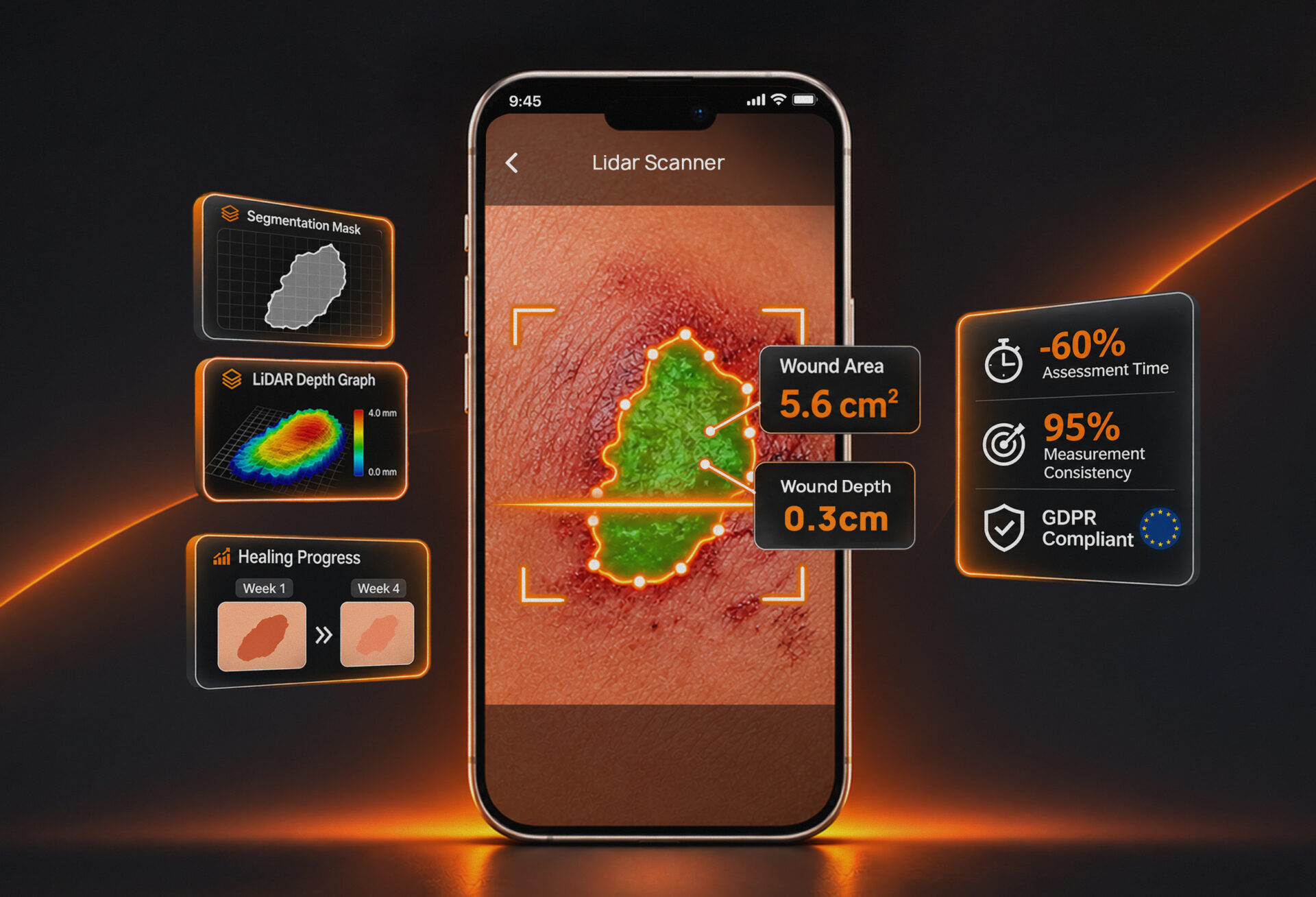

Discover how Obraz developed an AI-powered wound measurement platform for a European multi-site healthcare network, reducing assessment time by 60% and improving measurement consistency through secure computer vision.
Key Results
• 60% reduction in wound assessment time
• 95% improvement in inter-rater reliability
• 22% faster clinical escalation
•12 care facilities live across the network
• Zero findings related to wound documentation or data privacy in subsequent reported audits
Contact Our Healthcare AI Specialists
Executive Summary: The AI Wound Measurement Challenge in European Healthcare
This AI wound measurement case study shows how a leading European multi-site outpatient clinic and elder care network replaced ruler-and-tracing assessments with a secure, GDPR-compliant computer vision platform, and what changed for nurses, physicians, and auditors once it did.
The network treats more than 5,000 chronic wound patients every year, among them people living with diabetic ulcers, pressure injuries, and venous leg ulcers. For these patients, healing is judged by trend, so every measurement has to be comparable with the one taken weeks before it.
Manual measurement could not deliver that. Wound dimensions varied from nurse to nurse and site to site, documentation consumed time that belonged at the bedside, and strict European rules on patient images and clinical data left little room for legacy tools.
Obraz engineered a purpose-built computer vision platform that automates wound boundary detection, wound dimension calculation, and longitudinal healing analysis on the standard clinical tablets the network already used. Within six months of full deployment across 12 care facilities, the clinic network reported:
• Assessment time cut by 60%, from roughly 8 minutes to under 3 minutes per wound.
• 95% improvement in inter-rater reliability, giving physicians objective, repeatable data.
• 22% faster escalation of non-healing wounds to wound care specialists.
• Zero findings related to wound documentation or data privacy in subsequent reported audits.
The result is a new operating standard for AI-powered wound measurement in elder care: faster for nurses, more reliable for physicians, and defensible in front of regulators.
The Challenge: Manual Wound Assessment in a High-Compliance Healthcare Environment
Chronic wound care depends on precise, longitudinal tracking. A wound that is not measured the same way twice cannot be trusted to show whether it is healing, stalling, or deteriorating.
Across the client’s network, three connected problems made traditional assessment inefficient, clinically unreliable, and hard to defend under European regulation.
Inconsistent Wound Measurements and Clinical Data
Traditional ruler-based measurement and manual wound tracing are subjective by nature. Where one nurse draws the edge of a wound, another may draw it a few millimetres away, especially with irregular margins, slough, or surrounding maceration. Lighting, camera angle, and patient positioning add further variation.
Across multiple nurses and multiple facilities, those small differences compound into poor inter-rater reliability. Longitudinal comparisons then become unsafe: a wound that appears to be shrinking may simply have been traced differently, and a stalled wound may go unnoticed. Inconsistent boundaries directly weakened healing comparisons and, with them, clinical decision-making and the timing of interventions.
Time-Consuming Clinical Documentation and Nursing Workflows
Nurses spent approximately 8 to 10 minutes per patient on measuring the wound, photographing it, and recording the details in the electronic health record (EHR). Dimensions were noted by hand, images were handled separately, and historical records had to be searched and compared manually.
Across more than 5,000 patients and repeated visits, that administrative workload added up to hundreds of nursing hours each month. It also contributed to fatigue and burnout, and every minute spent on charting was a minute not spent on direct patient care. The network needed chronic wound management software that structured and automated the assessment workflow end to end, rather than adding another disconnected tool.
Healthcare Data Privacy and European Regulatory Requirements
Wound photographs are among the most sensitive data a care provider holds. They can show identifying features such as tattoos, scars, and distinctive skin markings, and they travel with embedded metadata. Managing them across multiple European facilities meant meeting strict requirements for:
• GDPR compliance for the processing of special-category health data.
• EU data residency, keeping patient images and records inside the EU.
• Encryption of data in transit and at rest.
• Anonymisation of patient images before they are processed or shared.
The client’s legacy systems could not satisfy these requirements together. They offered no automated anonymisation, limited access traceability, and no structured path from image capture to EHR, which left both a compliance exposure and an audit burden.
The Obraz Solution: Secure, AI-Driven Wound Assessment
Obraz worked side by side with the client’s clinical leadership to design and deploy a purpose-built platform for computer vision wound measurement. Rather than relying on generic off-the-shelf models, Obraz trained a specialised medical vision model on curated wound image datasets, using its own proprietary, zero-trust data annotation infrastructure so that every training image was handled under strict privacy controls.
The platform runs on the standard clinical tablets and smartphones the network already owned, and it slots into existing nursing routines: capture the image, review the result, confirm. No specialised hardware, no new workflow to learn.
Automated Edge AI Measurement for Wound Assessment
The nurse photographs the wound with the device camera. Computer vision models running at the edge, on the clinical device itself, detect the wound boundary and calculate the key measurements automatically:
► Wound area in cm².
► Maximum length and width.
► Estimated depth, derived from LiDAR/ToF depth data fused with the segmentation boundary and reported as an estimate to support trend tracking alongside the clinician’s own assessment.
This AI-powered wound measurement replaces the ruler, the tracing sheet, and the manual calculation. Because inference happens on the device, results appear within seconds of capture, and a standard smartphone or tablet camera is all the image capture workflow requires.
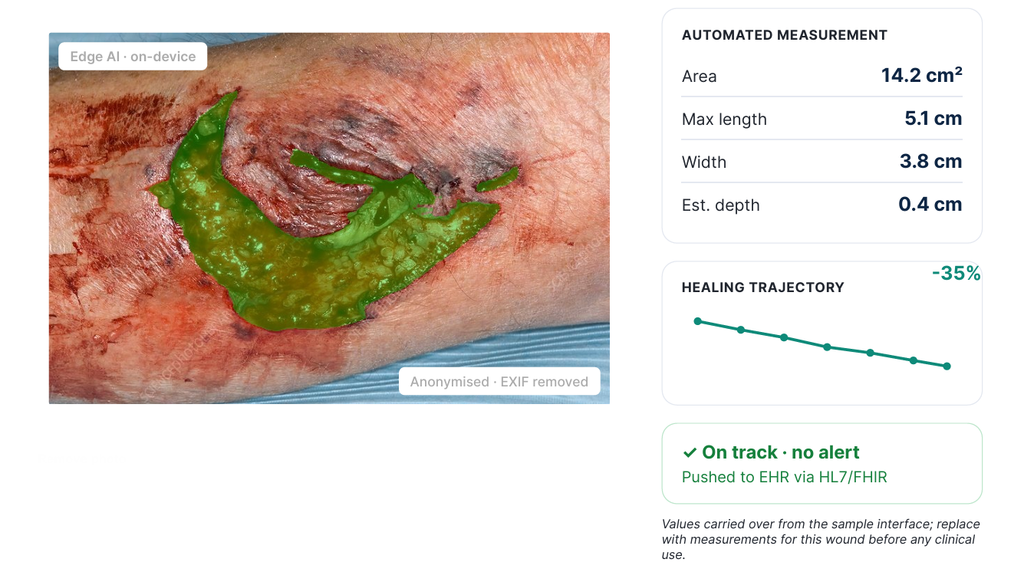
The segmentation model outlines the wound boundary on a standard tablet, then calculates area, length, width, and estimated depth in second
True-Scale Measurement with LiDAR and Depth Sensing
A photograph captures a wound’s shape and visible boundaries, but it does not inherently provide its actual physical dimensions. The same wound photographed from different distances can occupy different numbers of pixels, even though its real-world size remains unchanged. Without knowing the distance between the camera and the skin surface, computer vision alone cannot reliably convert pixel measurements into centimetres.
This is where LiDAR and depth-sensing technology become important. The camera answers “what shape is it?” The depth sensor answers “how far away is it?” Only by combining both can the system determine “how big is it in centimetres?”
Think of it like looking at a photocopy of a floor plan without a scale bar. You can clearly identify the shape and layout of a room, but you cannot determine whether it measures 3 metres or 30 metres. Similarly, a wound photograph provides its visual outline, but accurate physical measurement requires additional spatial information.
How LiDAR and Time-of-Flight (ToF) Technology Work
LiDAR (Light Detection and Ranging) measures the distance between the device’s sensor and the skin surface using infrared (IR) light pulses. It works on the fundamental principle of Time of Flight (ToF), which calculates distance by measuring how long light takes to travel to a surface and return to the sensor.
The process involves five key steps:
Light Emission: The LiDAR sensor emits thousands of invisible infrared light pulses towards the skin surface.
Light Reflection: These pulses strike the skin and reflect back towards the sensor.
Distance Calculation: Using the known speed of light and the measured travel time, the device calculates the distance between the sensor and different points on the skin.
Depth Map Generation: The system generates a depth map in which each pixel contains distance information rather than colour information, providing a spatial representation of the skin surface.
Time-of-Flight (ToF) sensors available on certain Android devices operate on the same underlying principle, making depth sensing possible across supported mobile hardware.
Fusing Depth Data with Wound Segmentation for Accurate Measurement
The real value comes from combining the depth map with the computer vision model’s wound segmentation output. Both the standard photograph and depth information are captured simultaneously, allowing the corresponding spatial measurements to be aligned with the wound boundary at the pixel level.
The segmentation model identifies the precise wound outline, while the depth-sensing component provides the corresponding distance and surface-depth information. By fusing these two data sources, the system can move beyond pixel-based measurements and derive more meaningful physical measurements, including wound dimensions and an estimated depth.
This approach helps account for variations in camera-to-skin distance and provides a more reliable basis for calculating wound area in cm² and tracking changes in wound depth over successive assessments.
By integrating LiDAR/ToF depth sensing with edge-based computer vision, the platform can deliver more consistent, spatially informed wound measurements directly on supported clinical devices. The resulting depth estimates complement the clinician’s assessment and support longitudinal wound monitoring, helping healthcare professionals make more informed decisions about healing progress.
Medical Image Segmentation for Accurate Wound Boundary Detection
Accurate measurement starts with accurate boundaries. The platform uses polygon-based medical image segmentation to trace the wound edge precisely, separating the wound bed from surrounding healthy skin, dressings, and background.
The model’s reliability comes from its training data. Specialised medical annotators outlined wound regions across a wide range of wound types, skin tones, lighting conditions and camera angles, and every annotation passed structured quality assurance. Training on that diversity is what keeps measurements consistent when image conditions change from one care home, ward or nurse to the next.
Longitudinal Healing Analytics and Automated Wound Monitoring
A single measurement is a snapshot; healing is a trajectory. The platform automatically overlays each new wound image on the patient’s historical images and plots the results as a healing trajectory graph, with visual side-by-side comparisons that clinicians can read at a glance.
The system also watches the trend. When a wound stalls or begins to deteriorate, AI-powered wound measurement analytics raise an alert so the case can be reviewed by a clinician and, where needed, escalated to a wound care specialist, rather than waiting for the next scheduled review to notice.
Seamless EHR/EMR Integration Through HL7 and FHIR-Compatible APIs
Measurements are only useful if they land where clinicians already work. Built on HL7- and FHIR-compatible APIs, the platform pushes structured wound data and securely linked images directly into the client’s existing electronic health record system.
That means automated clinical documentation instead of double entry, charting reduced from minutes to seconds, and no change to the clinical IT estate. As chronic wound management software, the platform behaves like part of the existing infrastructure, not a separate system to reconcile.
GDPR-Compliant AI for Healthcare: Secure Medical Data Processing
In healthcare, GDPR-compliant AI for healthcare is an architecture decision, not a legal checkbox added at the end. Obraz built privacy and security into every layer of the wound measurement platform, from the moment an image is captured to the moment a measurement reaches the patient record, so that sensitive clinical images and patient information stay protected across every facility in the network.
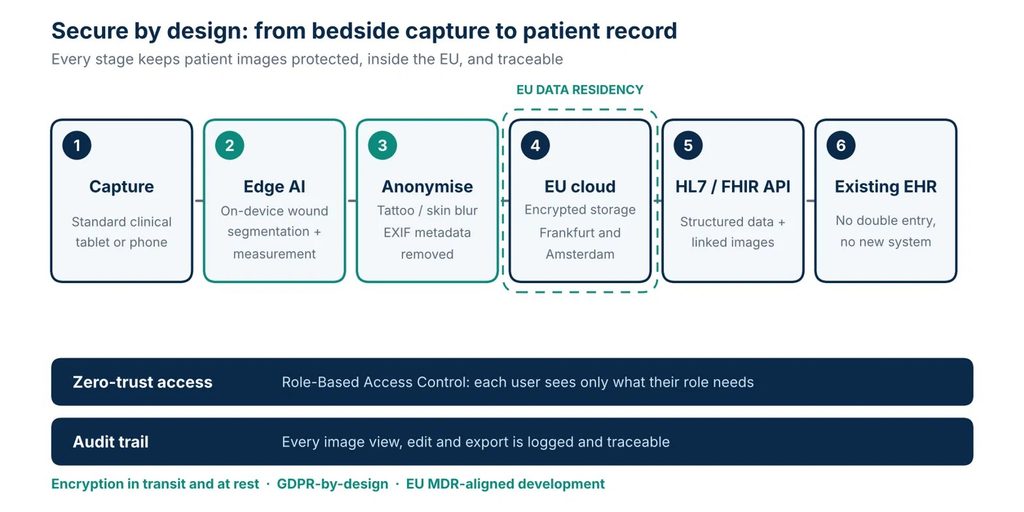
Privacy and security controls are built into every stage, from bedside capture to the patient record
EU Data Residency and Secure Healthcare Infrastructure
All patient images and clinical data are hosted on secure cloud infrastructure located inside the European Union, in data centres in Frankfurt and Amsterdam. Data never leaves EU jurisdiction. Information is protected with encryption in transit and at rest, supported by key management and standard data protection practices.
Automated Patient Image Anonymisation
Privacy protection starts at the image. The platform automatically anonymises each wound photograph before it is processed or stored for analytics:
• Identifying marks, including tattoos, are detected and handled automatically.
• AI-driven blurring of surrounding healthy skin, where implemented, reduces the identifying detail visible around the wound.
• EXIF metadata removal strips location, device, and timestamp data that could link an image back to a person.
Anonymised medical image processing lets clinicians and AI models work with the clinically relevant region of the image while limiting what could identify the patient. It is a core safeguard for any healthcare AI workflow that handles photographs.
Zero-Trust Architecture and Role-Based Access Control
The platform assumes no user or device is trusted by default. Role-Based Access Control (RBAC) restricts each user to the patient information their role requires, so a nurse, a physician, and an administrator each see only what they need.
Every action is traceable. Audit logs record each image view, edit, and export, creating a digital trail of who accessed what, and when. Controlled access and full traceability give legal, compliance, and clinical teams the evidence they need on demand.
EU MDR-Aligned Healthcare AI Development
Software that supports clinical decisions can fall under the EU Medical Device Regulation (MDR), so regulatory requirements were considered during architecture and development rather than after it. Obraz designed the platform with EU MDR software-as-a-medical-device (SaMD) principles in mind, including secure development practices, controlled change management and thorough technical documentation.
In European deployments, this discipline matters as much as model accuracy. Well-documented, securely developed software shortens procurement and audit conversations and gives clinical leaders confidence that the system can be defended in a regulated environment.
Results: Clinical Excellence Meets Financial ROI
Within six months of full deployment across 12 care facilities, this AI wound measurement case study delivered measurable gains on every outcome the network cared about: nursing time, clinical reliability, patient safety, and compliance. AI-powered wound measurement turned a slow, subjective process into a fast, objective one.
| Performance Metric | Before Implementation | After Implementation / Reported Result |
| Wound assessment time | Approximately 8–10 minutes | Under 3 minutes |
| Assessment time reduction | Manual workflow | 60% reduction |
| Inter-rater reliability | Subjective manual measurements | 95% improvement |
| Clinical escalation | Existing manual identification process | 22% faster escalation |
| Audit findings | Legacy documentation and privacy risks | Zero reported findings related to wound documentation or data privacy |
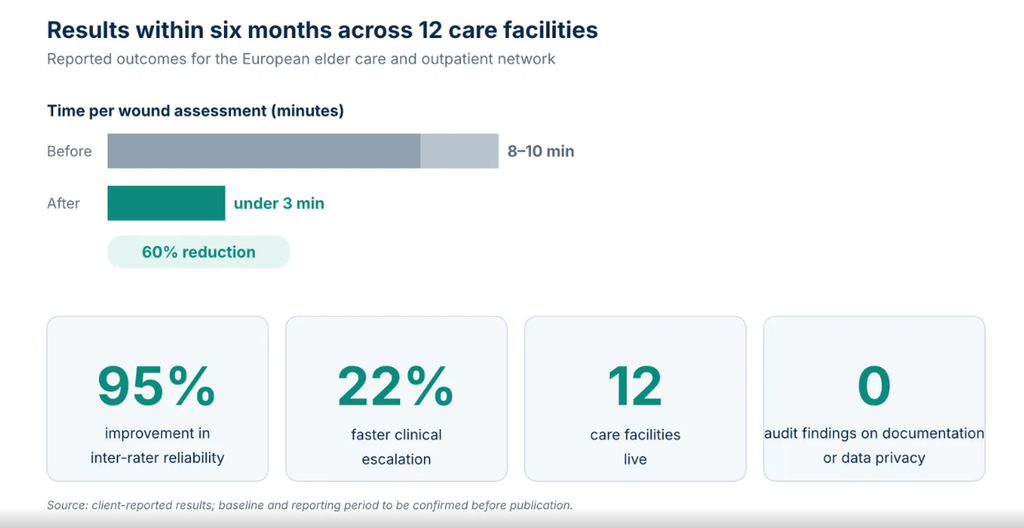
Faster Wound Assessment and Clinical Documentation
Automated measurement cut documentation from roughly 8 minutes to under 3 minutes per wound, a 60% reduction. With measurement, image handling and charting handled in one flow, nurses no longer re-enter the same data in three places.
The operational effect was immediate: hundreds of nursing hours freed every month and returned to direct patient care. The network gained capacity to treat more patients without increasing headcount.
Improved Measurement Consistency and Clinical Decision-Making
Computer vision-based wound boundary detection replaced subjective ruler and tracing measurements with objective, repeatable results, driving a 95% improvement in inter-rater reliability. Two nurses photographing the same wound now arrive at the same numbers.
For physicians, that consistency makes healing trends trustworthy. Decisions about dressings, offloading, or specialist input rest on measured progression rather than on interpretation, and accurate early trend detection helps avoid unnecessary specialist referrals.
Faster Identification and Escalation of Non-Healing Wounds
Longitudinal monitoring and automated alerts flag wounds that are not healing as expected earlier than periodic manual review can. The 22% improvement in escalation time means non-healing wounds reach wound care specialists sooner. For patients with diabetic ulcers or pressure injuries, earlier specialist attention can reduce the risk of complications.
Improved Regulatory Audit Outcomes
Structured wound documentation, secure patient image processing and digital audit trails changed what auditors see. In subsequent internal and external audits, the network reported zero findings related to wound documentation or data privacy. Every measurement, image view, and export is traceable, so evidence is available on request instead of assembled under pressure.
“Obraz didn’t just give us a software tool; they built us a secure, compliant ecosystem. Our nurses are no longer bogged down by manual charting, and our physicians finally have objective, reliable data to make faster, better-informed treatment decisions. The GDPR-by-design architecture gave our legal team complete peace of mind.”
— Chief Medical Officer, European Elder Care and Outpatient Network
Traditional Wound Assessment vs. AI-Powered Wound Measurement
The table below sets the client’s previous workflow beside the Obraz AI-powered workflow, step by step.
| Traditional Wound Assessment | Obraz AI-Powered Workflow |
| Manual ruler-based measurements | Automated computer vision measurements |
| Subjective wound boundary identification | Polygon-based wound segmentation |
| Manual wound area calculations | Automated area calculation |
| Manual historical image comparison | Digital healing trajectory analytics |
| Disjointed clinical documentation | HL7/FHIR-compatible EHR integration |
| Manual image handling | Automated anonymisation and controlled access |
The AI-enabled workflow improves measurement consistency by removing human judgement from boundary detection, clinical documentation by writing structured data straight into the EHR, and operational efficiency by giving nurses back the minutes that manual charting used to take.
Why European Healthcare Innovators Choose Obraz
In health tech, rapid AI innovation cannot come at the expense of patient security. Obraz combines computer vision engineering, secure medical data annotation and enterprise AI development to build specialised solutions for regulated healthcare environments, and this project shows each capability at work.
Compliance-First AI Engineering: Security, privacy and regulatory considerations are built into the solution architecture from day one. That is why this platform combined EU data residency, anonymisation and audit trails with zero reported audit findings on wound documentation or data privacy.
Proprietary Medical AI Development: Specialised medical datasets and in-house annotation infrastructure mean models are trained on diverse, ethically sourced clinical data, supporting accuracy across skin tones, lighting conditions and wound types.
Accurate Medical Image Annotation: Structured annotation and multi-stage quality assurance underpin reliable medical computer vision. The polygon boundaries behind this platform’s measurements started as carefully verified annotations.
End-to-End Computer Vision Development: From dataset preparation and model development to integration and deployment, one team owns the whole pipeline, so nothing is lost in handover.
Frictionless Clinical Integration: AI built around existing healthcare systems and clinical workflows. Nurses kept their tablets and their routines, and the EHR kept its place as the single source of truth.
Healthcare Computer Vision Capabilities & Technical Implementation
Behind the clinical results sits a full healthcare computer vision stack. The capabilities below were applied in this project and form part of Obraz’s wider healthcare AI engineering practice.
Medical Image Processing and Annotation Capabilities
Medical image segmentation is only as good as the data behind it. Obraz’s annotation capabilities for this project covered:
- Medical image annotation by trained annotators
- Polygon segmentation of wound regions
- Wound boundary detection
- Medical image classification, where implemented
- Dataset quality assurance through multi-stage review
- Annotated medical dataset preparation
AI Model Development and Edge Deployment
Obraz developed and validated the wound models end-to-end:
- Specialised computer vision model development for wound boundary detection
- Automated wound dimension calculations: area, length, width and estimated depth
- Edge AI deployment on clinical tablets and smartphones for fast, on-device results
- Model validation across different image conditions, including lighting, angle, skin tone and wound type
- Performance and reliability considerations such as inference speed, device variability and consistent output
Healthcare System Integration and Data Security
The platform connects to clinical systems and protects data at every step:
- HL7/FHIR-compatible API integration
- EHR/EMR connectivity for structured data and securely linked images
- Secure medical image processing, with automated anonymisation
- Role-Based Access Control across user roles
- Audit logging of views, edits and exports
- EU data residency in Frankfurt and Amsterdam, as part of a GDPR-compliant AI for healthcare architecture
Build Secure AI-Powered Healthcare Solutions with Obraz
Obraz helps healthcare organisations develop specialised computer vision and AI engineering solutions for clinical assessment, medical image analysis and healthcare workflow automation, without compromising patient privacy or regulatory standing.
If you are a healthcare technology provider, a MedTech company or an enterprise healthcare organisation with an AI development requirement, we would like to hear about it.
Contact Our Healthcare AI Specialists Today | Request a Secure, Confidential Demo
Frequently Asked Questions About AI Wound Measurement
1) How Does AI-Powered Wound Measurement Work?
A clinician photographs the wound with a standard tablet or smartphone. Computer vision models identify the wound boundary in the image and automatically calculate wound area, maximum length and width, plus an estimated depth. The result is stored against the patient’s record and compared with earlier measurements, so AI-powered wound measurement replaces manual rulers and tracings with consistent digital results.
2) How Does Computer Vision Support Automated Wound Measurement?
Computer vision wound measurement detects where the wound ends and healthy skin begins, calculates the enclosed area and dimensions from that boundary, and applies the same logic to every image. Because the method does not change between nurses or sites, assessments are consistent and healing trends can be compared with confidence.
3) What Role Does Medical Image Segmentation Play in Wound Assessment?
Medical image segmentation is the step that outlines the wound. Polygon segmentation draws a precise boundary around the wound region, separating it from surrounding skin. Area and boundary calculations are derived directly from that outline, so segmentation accuracy sets measurement accuracy. Models trained on carefully annotated datasets keep it reliable across lighting and image conditions.
4) How Can Chronic Wound Management Software Improve Clinical Workflows?
Chronic wound management software reduces manual work at each step. Automated measurement removes ruler and tracing time, historical image comparison shows healing progress without manual lookup, and EHR integration writes structured results into the patient record. Together, they cut documentation time and support continuous, longitudinal monitoring.
5) How Does GDPR-Compliant AI Protect Patient Data in Healthcare?
GDPR-compliant AI for healthcare protects patient data through several layers: EU data residency keeps data inside the EU, encryption protects it in transit and at rest, anonymisation removes identifying marks and metadata from images, role-based access controls limit who can see what, and digital audit trails record every view, edit and export.
6) Can AI Wound Measurement Systems Integrate with Existing EHR/EMR Platforms?
Yes. HL7/FHIR-compatible APIs allow the wound assessment system to exchange structured data and linked images with existing EHR and EMR platforms. Measurements flow directly into the patient record, which avoids duplicate entry and leaves the existing clinical IT infrastructure in place.